
The Occupier Blueprint Volume 2: How Construction Costs are Impacting Occupiers

How construction costs are impacting occupiers
In the current state of the Atlanta office market, buildings are trading, and bases are being reset. Concessions have expanded, and occupiers have a lot of leverage. While the environment is positive for occupiers, there is a real cost and impact that many occupiers may not be appropriately planning for. These construction cost implications can turn what seems like a great opportunity into a more complex decision with a potentially costly capital expense.
After demand for space fell following COVID, the development pipeline in Atlanta collapsed. Now, only a handful of office buildings are currently under construction across the city. Development and construction costs and associated economics stopped working. Spiking material costs, sustained labor cost inflation, higher interest rates, and growing uncertainty around tariffs pushed construction costs to a point where new development only pencils at unsustainable rent levels.
Rising construction costs as Atlanta development slows
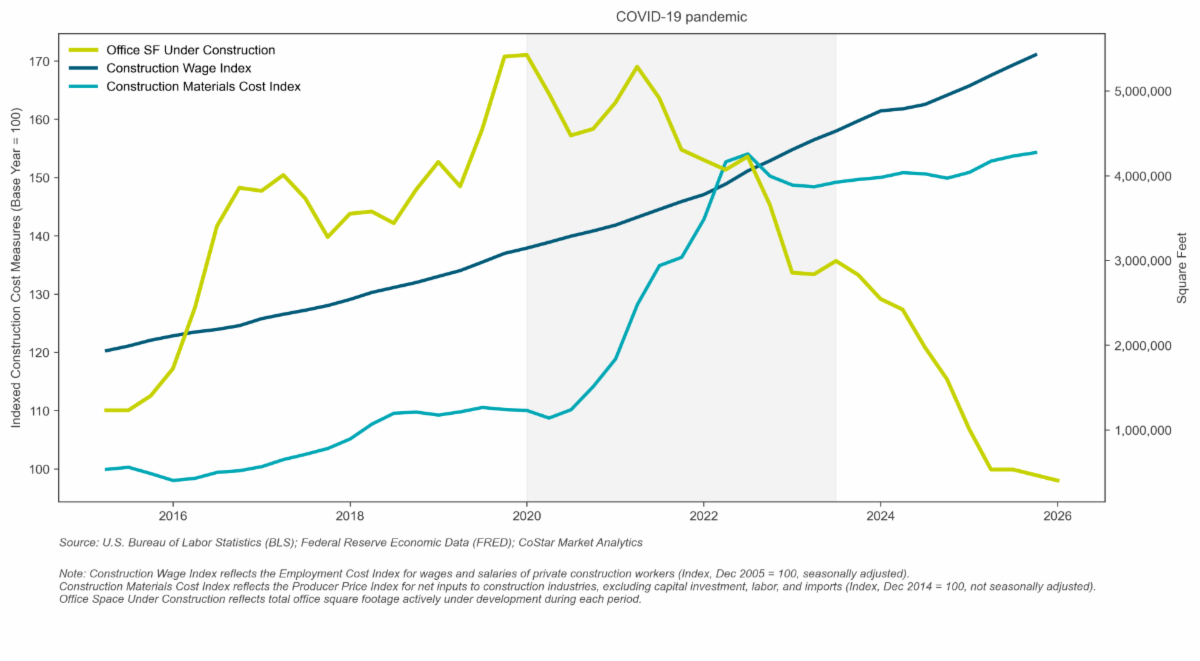
While construction inflation is most visible in ground-up development, its impact is often more acute—and more disruptive—for office tenants navigating a relocation or renewal.
We are consistently advising companies whose leases expire in the next 12–24 months. The pattern is familiar. An occupier reassesses its footprint while considering the rise of hybrid work, post-COVID utilization shifts, and workforce changes potentially being accelerated by AI. The conclusions are rational: less density, more collaboration space, better experience, more efficiency.
The market, on the surface, appears cooperative. Availability is elevated. Landlords are motivated. A competitive process yields attractive economics and a meaningful tenant improvement allowance. From a lease standpoint, the transaction makes a lot of sense.
During the process, the construction budget arrives, and then the real work begins.
What many tenants underestimate is how materially build-out costs have been reset. Across recent projects, we are seeing hard construction pricing—before design, engineering, construction management, and project management fees—regularly fall in the $85–$125 per square foot range for standard office interiors. More design-forward or high-end repositionings can exceed $150–$200 per square foot.
This escalation is broad-based. Steel studs, glazing systems, lighting packages, mechanical and electrical equipment, paint, and specialty finishes have all increased. Furniture, cabling, and technology infrastructure have experienced parallel inflation. Labor volatility has shortened bid validity windows. Pricing that once held for 60–90 days may now expire in 15–30 days.
What this means for your office strategy
Are you paying market rent based on yesterday’s pricing or today’s competition? Are you occupying a building that has already reset, is approaching a reset, or competing directly with a reset asset in your submarket? If your landlord hasn’t invested in amenities or capital improvements, are you leveraging the concessions from reset buildings to extract better economics in your current lease discussions?
These dynamics are highly building and ownership specific. As tenant-only advisors, our role is to identify where landlords are most motivated, model competitive concession scenarios across reset and non-reset assets and translate those dynamics into real leverage for occupiers. Whether you’re evaluating a renewal, relocation, or consolidation, understanding where pricing power truly sits can materially change the outcome—and we can help you apply it.
Atlanta landlord concession index
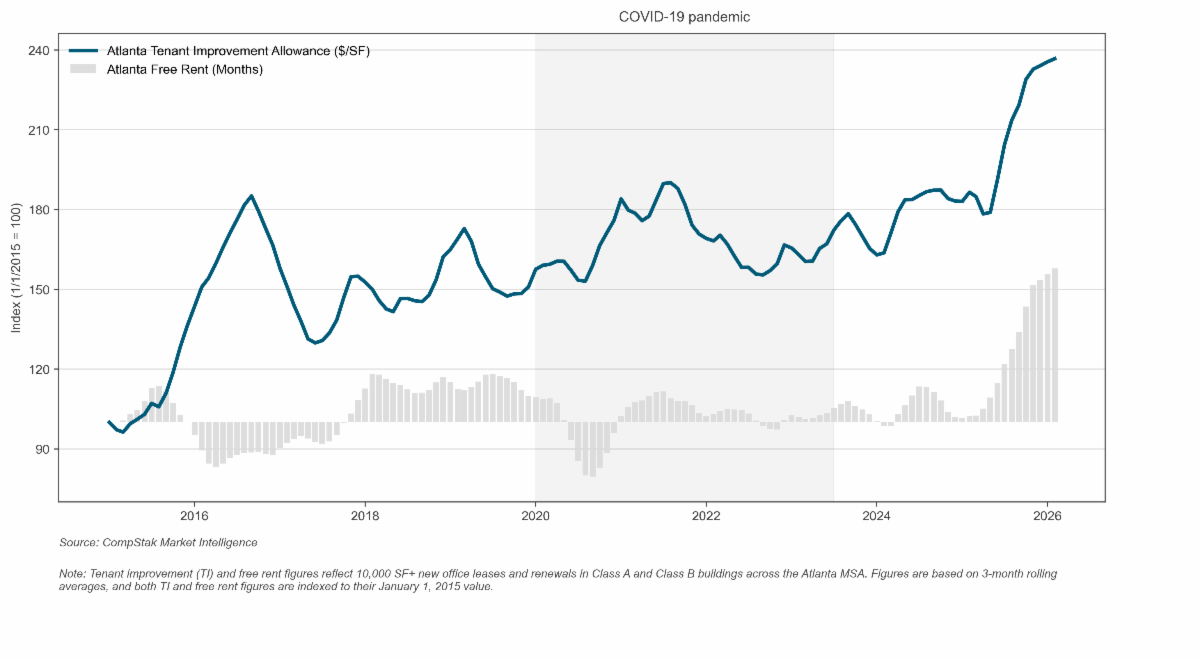
This is where sophisticated occupier advisory matters.
Our mandate is not just negotiating concessions; it is to underwrite total occupancy cost and protect against downstream exposure. That means:
- Driving maximum TI and concessions through a competitive process and credit positioning
- Bringing project management experts into the process early
- Identifying soft costs and scope gaps that rarely appear in first-round estimates
- Aligning schedule discipline with pricing strategy
In volatile cost environments, disciplined project management is a financial control mechanism. This includes the proper due diligence on whether the owners competing for the project have the right capital structure to execute on their proposal.
For companies with expirations in the next 12–36 months, the window to create leverage is now. The tenants who outperform in this cycle are not simply negotiating better rents; they are managing construction risk with the same rigor they apply to capital allocation decisions.
That is the difference between completing a transaction and executing a comprehensive strategy.